he afternoon sun hits Fortaleza's Praia do Futuro like a hammer, and the smell of grilled shrimp skewers mixes with diesel fumes from passing buggies. This is not the postcard Bahia of travel brochures. Fortaleza is a working city of 2.7 million that happens to have 34 kilometers of urban beaches, and that tension—between grit and glamour—defines the place. I spent three weeks there last February, and the first thing that struck me was how locals talk about their own waterfront: with pride, yes, but also a shrug. "The ocean is for everyone," a lifeguard named Cleber told me。"but the good part of the city is inland." He wasn't wrong.Fortaleza's geography tells the story. The city sprawls west from the port, and the further you go, the more the income drops. Aldeota and Meireles, the affluent eastern neighborhoods, have wide avenues, gated condos, and a shopping mall that could be in Miami. Drive twenty minutes south to Jangurussu, and you're in a different Fortaleza—unpaved side streets, open sewers, and a palpable sense of neglect. The 2014 World Cup brought a new arena, the Castelão, and a light-rail line that still doesn't reach the poorest districts. A taxi driver I met, who asked not to be named, summed it up: "They built stadiums for tourists and left the favelas alone." That's a common sentiment, and it's not just cynicism. The city's homicide rate。while down from its 2018 peak, remains among Brazil's highest, and drug trafficking in the western suburbs has reshaped daily life. Fortaleza is not a dangerous city everywhere—I walked alone at night in Meireles without incident—but the inequality is spatial and stark.What keeps me thinking about Fortaleza, though, is its cultural stubbornness. The Mercado dos Peixes。
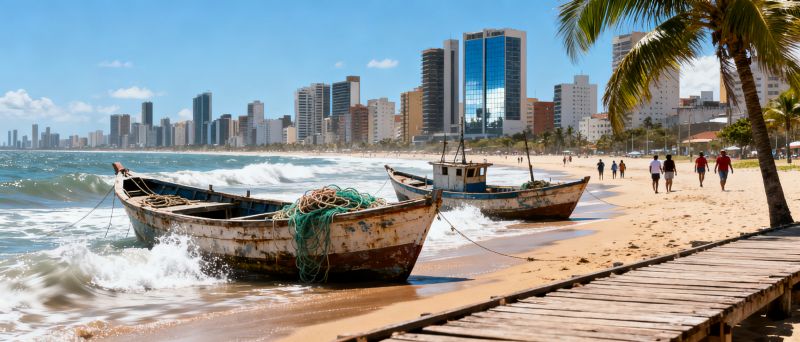
a fish market near the beach, is chaos at 6 a.m.: vendors shouting prices for tilapia and lobster, old men playing dominoes on overturned crates, women selling coconut candy from plastic bins. No one is performing for tourists. The forró bars in Praia de Iracema thump until 3 a.m., and the dancing is unselfconscious, sweaty, and joyful. I watched a seventy-year-old man in a faded Flamengo jersey teach a group of teenagers a passo do forró, and nobody took out a phone to film it. That kind of authenticity is rare in coastal cities that have been commodified. Fortaleza hasn't lost it yet. The city's annual carnival, held in February, is less polished than Rio's but more participatory—entire neighborhoods organize their own blocos, and the lines between spectator and participant blur.Economic pressures are mounting, though. Fortaleza is a major hub for wind energy, and the coastline north toward Jericoacoara is dotted with turbines that have transformed the landscape. Some locals welcome the jobs;others resent the visual intrusion and the foreign companies profiting from Brazilian wind. A fisherman in Icarai told me the turbines had changed the wind patterns—"It's not the same breeze。" he said, without elaborating. That's anecdotal, sure, but it points to a broader unease. Tourism is another engine, but the city struggles with infrastructure: sewage treatment lags far behind needs, and during the rainy season—which is increasingly erratic—flooding clogs major arteries. The state government has promised upgrades, but promises are cheap in Ceará. What I noticed most was a kind of pragmatic resilience: people fix what they can and ignore what they can't. A restaurant owner in Mucuripe rebuilt his deck after a storm surge and laughed when I asked if he worried about climate change. "I worry about tomorrow's fish prices," he said. That's Fortaleza in a sentence—immediate, unsentimental, and stubbornly alive.
Would I go back?Yes, but with adjusted expectations. Fortaleza won't coddle you. The beaches are beautiful but the undertow is real, and the city's charm lies in its refusal to pretend otherwise. It's a place where the infrastructure is fraying and the music is loud, where the rich hide behind walls and the poor dance in the street. That friction is what makes it worth writing about—and worth visiting with open eyes.